
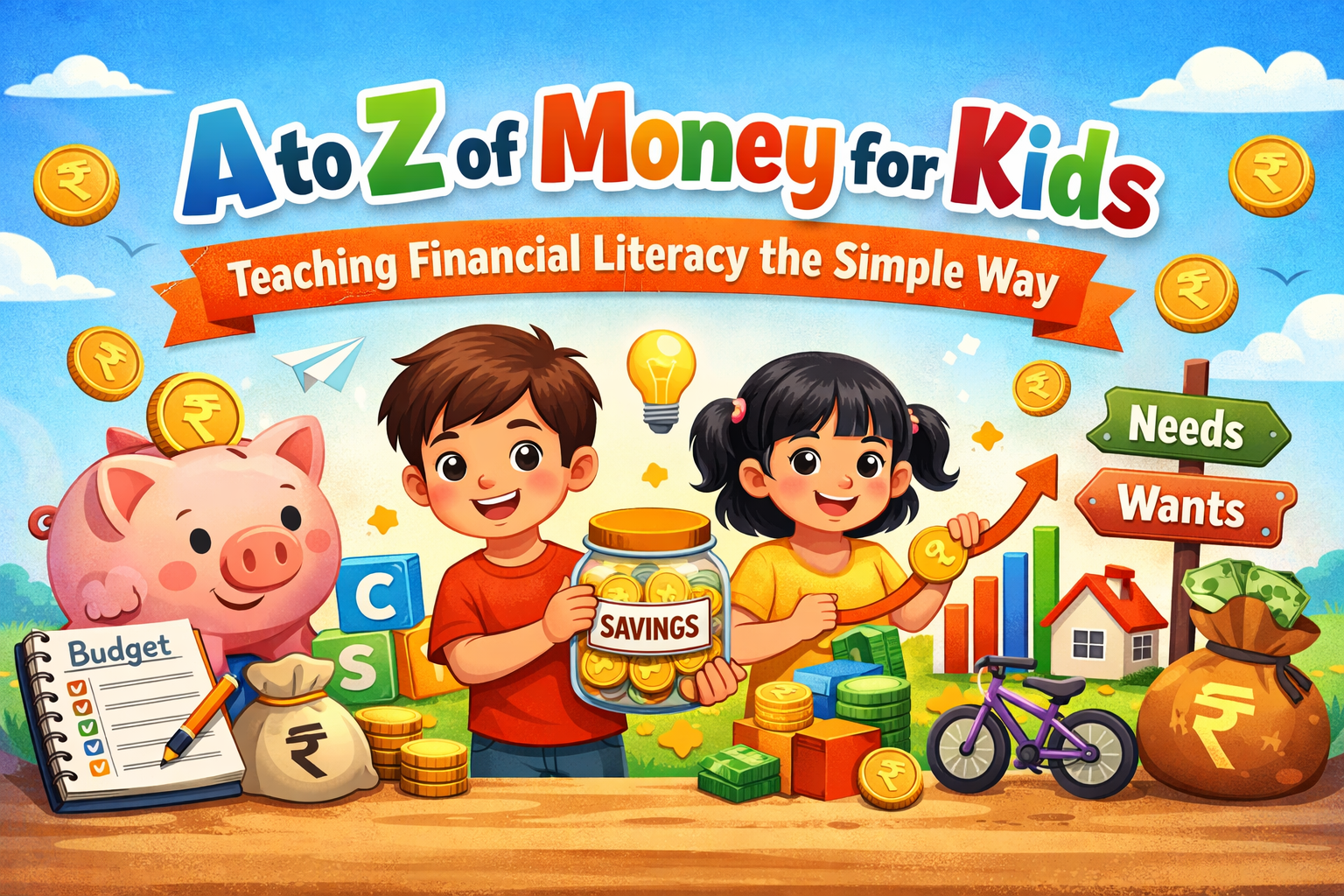
Financial literacy is one of the most important life skills that children should learn early. Understanding money helps kids make smarter decisions about saving, spending, and investing when they grow up.
One of the easiest ways to introduce finance concepts to children is through the A to Z Money Alphabet. This fun method connects each letter with a financial concept that kids can easily understand.
Let’s explore the A–Z of Money for Kids.
A – Allowance
Allowance is a small amount of money that children receive regularly from parents for completing chores or responsibilities.
It teaches children:
- Responsibility
- Budgeting
- Saving habits
Example: A child receiving ₹100 per week can learn how to divide it between spending and saving.
B – Budget
A budget is a simple plan for how to spend and save money.
Teaching kids budgeting early helps them understand:
- Money limits
- Smart spending
- Avoiding unnecessary purchases
Example: If a child has ₹200, they might spend ₹120 and save ₹80.
C – Credit
Credit means borrowing money and paying it back later, usually with extra money called interest.
Children should learn that credit can be helpful but must be used carefully.
D – Debt
Debt is money that someone owes to another person or institution.
For example, if someone borrows ₹500 from a friend and has not repaid it yet, that amount becomes debt.
E – Earnings
Earnings are the money people receive for doing work.
Kids can earn money by:
- Doing chores
- Helping neighbors
- Selling handmade crafts
This teaches the value of hard work and income.
F – Financial Goals
Financial goals are things you want to achieve using money.
Examples for kids:
- Buying a bicycle
- Saving for a toy
- Buying books
Goals encourage disciplined saving.
G – Giving
Giving means sharing some of your money with people in need or donating to charity.
This helps children develop:
- Compassion
- Social responsibility
- Gratitude
H – Hard Work
Money usually comes from effort and hard work.
Children should understand that earning money requires dedication and persistence.
I – Interest
Interest is extra money that is either:
- Earned on savings
- Paid when borrowing money
Example: If you save ₹1,000 in a bank, the bank may pay you interest.
J – Job
A job is work people do to earn money.
Explaining jobs to kids helps them understand how adults generate income.
K – Keep Track
Keeping track means recording how much money you earn, save, or spend.
Kids can maintain a small money diary or use a savings chart.
L – Loan
A loan is money borrowed from a bank or person that must be repaid later.
It is important for kids to understand that loans must always be returned.
M – Money
Money is what we use to buy goods and services.
It can be:
- Coins
- Currency notes
- Digital money
Teaching the concept of money helps children understand trade and value.
N – Needs
Needs are things we must have to live.
Examples include:
- Food
- Clothes
- Shelter
- Education
Kids should learn that needs must come before wants.
O – Opportunity
Opportunity means a chance to earn or grow money.
Example:
Selling homemade crafts during a school fair.
Learning to recognize opportunities builds entrepreneurial thinking.
P – Piggy Bank
A piggy bank is a simple tool to save money.
Children can store coins and small notes and watch their savings grow.
This creates the habit of saving regularly.
Q – Quality
Quality means buying things that last longer and work better.
Kids should learn that sometimes paying a little more for quality saves money in the long run.
R – Reward
A reward is money or something valuable given for completing a task or achieving a goal.
Rewards encourage children to stay motivated.
S – Savings
Savings are money kept aside for future use instead of spending immediately.
Saving teaches patience and financial discipline.
T – Trade
Trade means exchanging goods or services with others.
Example: Trading toys or buying snacks from a shop.
Trade is the foundation of economic activity.
U – Use Wisely
Money should always be used wisely.
Children should learn to think before spending and ask:
- Do I need this?
- Is it worth the price?
V – Value
Value means how useful or important something is.
Kids should learn to spend money on things that provide real benefit.
W – Wants
Wants are things we would like to have but do not necessarily need.
Examples:
- Video games
- Toys
- Chocolates
Understanding wants helps control unnecessary spending.
X – Exchange
Exchange means giving something and receiving something in return.
Example: Giving money to buy a toy or trading items with friends.
Y – Yield
Yield is the money earned from savings or investments over time.
Although advanced for kids, it introduces the idea that money can grow.
Z – Zero Debt
Zero debt means not owing money to anyone.
It represents financial freedom and good money management.
Why Teaching Financial Literacy to Kids is Important
Children who learn money concepts early develop better financial habits in adulthood.
Financial education helps kids:
- Understand the value of money
- Avoid unnecessary debt
- Develop saving habits
- Become financially independent in the future
Parents, schools, and communities should encourage early financial education.
Final Thoughts
Teaching kids about money does not have to be complicated. The A–Z Finance Alphabet makes financial learning fun, simple, and memorable.
When children understand concepts like saving, budgeting, and spending wisely, they build a strong foundation for financial success in life.
Start teaching your kids about money today—it’s one of the most valuable lessons you can give them.

0 Comments